Breathe Easy: Real-World Ways to Manage Everyday Stress

Photo by Freepik

By Guest Blogger Julia Merrill

We live in a time where your smartwatch can track your pulse — but not your peace. The truth? Everyone’s stressed. From running late to handling constant notifications, calm feels like an endangered species. Still, it’s entirely possible to reclaim your mental balance — even in chaos.


TL;DR

  • Stress is normal. Constant stress isn’t.
  • You can re-train your body to chill faster.
  • Small daily habits compound into real peace.

How to Reset in 60 Seconds

When you feel tension rising, here’s a micro-method that works:

  1. Pause — put both feet on the floor.
  2. Name the feeling. (“I’m overwhelmed.”)
  3. Exhale longer than you inhale.
  4. Do one grounding thing — refill water, stretch, or open a window.

Apps like Calm can walk you through breathing or short mindfulness breaks if you need structure.

The goal isn’t to feel perfect — it’s to feel present.


The Everyday Stress Checklist

  • Drink water before coffee
  • Get 10 minutes of daylight
  • Move every two hours
  • Say no once today
  • End the day with zero screens for 30 minutes
  • Laugh at something dumb (seriously)
  • Stretch before bed

If you want accountability, try using a free reminder app like Todoist — not for productivity, but to keep calm intentionally.


FAQ

Q: Is stress always bad?
No. It sharpens focus in short bursts. It only hurts when it’s constant.

Q: How can I calm down instantly?
Box breathing: in 4 seconds → hold 4 → out 4 → hold 4. Or go for a 5-minute walk. FitOn has free, quick movement routines that help reset energy fast.

Q: What if I can’t relax even on weekends?
That’s a sign of emotional carryover — your mind’s still “on the clock.” Try journaling or guided relaxation from Insight Timer before bed.


Common Stressors and Real Fixes

Stress TriggerQuick ResetOngoing Habit
Work overloadTake a short walkBlock 10 minutes between meetings
Negative newsMute alertsCheck the news once daily
Sleep debtNap for 20 minKeep a steady bedtime
Money worriesBreathe before budgetingUse apps like YNAB or Mint for visibility
LonelinessText someonePlan one call or meetup a week

When a Career Change Is the Calm You Need

Sometimes, no breathing trick fixes the real issue — because it’s not about stress management, it’s about the stress source.

If your job constantly leaves you drained, the most powerful thing you can do isn’t another meditation. It’s creating a new environment altogether. Starting your own venture can turn burnout into autonomy, giving you back your time, your energy, and your sense of direction.

Tools like ZenBusiness make the logistics of launching simpler — handling the paperwork so you can focus on what actually calms you: building something that fits your life.

The cure for endless stress isn’t tougher skin, it’s a truer setup.


Small Grounding Boosts You Can Try

Keep a tactile fidget like the Calm Strips sticker nearby — it helps you refocus quietly during tense moments. Or if you prefer audio grounding, try a “brown noise” loop on Spotify to create instant calm in noisy environments.


Quick Bullet Reminders for Sanity

  • Stretch while your coffee brews
  • Mute one notification group permanently
  • Take 3 deep breaths before answering a stressful email
  • Keep your phone out of your bedroom
  • Treat relaxation as maintenance, not indulgence

Conclusion

Stress will visit — that’s life. But peace comes from how you greet it. Whether you’re breathing deeper, walking more, or walking away from what no longer fits, calm isn’t a luxury. It’s strategy.


Julia Merrill is a retired board certified nurse practitioner. In her many years in the medical field, she experienced challenges that a lot of her patients came across when dealing with their medical care. She made it her goal to bridge the gap between those who receive care and those who provide it. One of the biggest things she learned was that doctors are human. They may not always know the answers to what is ailing their patients. She believes this is why it is so important for patients to be concise, honest, and organized when seeking treatment.

Ms. Merrill shares tips she has developed to help patients be their own advocate in seeking medical care, dealing with insurance companies, and how to contribute to their own health and well-being. Her advice? Befriend your doc! Visit her on the web at https://befriendyourdoc.org.

No A.I. was used in crafting this article.

Creating Harmony at Home: Making Multigenerational Living Work

Image by Freepik

By Guest Blogger Bella Reilly

Living under one roof with grandparents, parents, and children can be as enriching as it is challenging. Shared stories, different viewpoints, and pooled resources bring potential, but so do clashing routines and conflicting needs. In a culture that prizes independence, integrating three generations into one household requires more than goodwill — it demands daily decisions, patient listening, and structural planning. Here’s how to cultivate a balanced, respectful, and vibrant multigenerational home.

Shared Activities Build Connection
The easiest bridge between generations might be as simple as the card table. Families that schedule shared intergenerational game nights or watch movies together are more likely to report feeling emotionally connected. These shared moments can ease tensions before they arise, acting as a preventive balm rather than a reactionary bandage. The trick lies in finding activities that don’t just entertain but invite participation from everyone, whether that’s cooking a traditional meal or planting a garden together. Nobody needs to love every activity, but everyone should feel invited to contribute. These rituals turn the home from a shared space into a shared experience.

Respect Privacy & Personal Space
Harmony doesn’t require constant togetherness. In fact, one of the most overlooked contributors to household tension is the failure to establish clear personal space boundaries. Grandparents may need quiet in the afternoon while young kids play full volume, or a parent might need ten minutes alone before launching into evening duties. Bedrooms with door policies, rotating quiet times, and even designated solitude corners can go a long way in diffusing everyday friction. It’s not about isolation, but permission to step back and recharge. When boundaries are clear, togetherness becomes a choice rather than a burden.

Home Warranty Peace of Mind
More people means more wear and tear on appliances, which also means more opportunities for tension when something breaks. Arguments can start over who used what, who broke it, and who’s supposed to fix it. One way to neutralize this trigger is understanding what to look for in home warranty appliance coverage, so repairs don’t derail daily routines. Coverage plans create a buffer — not just for budgets, but for relationships too. When the fridge dies or the dishwasher groans, everyone knows what happens next. That certainty is priceless.

Design Homes for Flexibility
Architecture isn’t neutral in a multigenerational home, it shapes how people interact. Small layout changes, like using separate entrances for privacy, can change how often people bump into each other, interrupt, or unintentionally intrude. Rooms that convert — office by day, bedroom by night — or zones that give each generation its own “wing” can reduce friction that builds invisibly. Think about traffic patterns and sound bleed, about shared bathrooms and refrigerator real estate. The physical space must adapt to the people in it, not the other way around. If the home flows well, family relationships tend to follow.

Divide Chores Fairly
Shared living only works when the workload is visible and shared among all generations. A transparent system makes contributions feel like participation, not pressure.

  • Map tasks to strengths. Let each generation gravitate toward roles they enjoy or handle well — whether that’s cooking, cleaning, or childcare.
  • Set expectations together. Avoid the friction of unspoken assumptions by naming what needs to be done and who’s taking it on.
  • Rotate responsibilities regularly. A chore shouldn’t become a lifetime assignment; variety keeps resentment low and empathy high.
  • Schedule weekly reviews. Revisit who’s doing what and recalibrate when things feel lopsided or life gets hectic.
  • Make contributions visible. Acknowledging effort, even casually, prevents invisible labor from quietly poisoning relationships.

Communicate Across Generations
Words work differently for each age group. It helps to adapt your communication style depending on who you’re talking to — what feels respectful to one person may feel evasive to another. Elders might want more context, younger members more brevity. Tone, volume, and even body language shift meaning, and everyone benefits from practicing clearer signaling. Regular family storytelling, whether at dinner or during errands, builds an emotional glossary that helps in trickier conversations. Misunderstandings shrink when language flexes with care.

Explore Health Together
One surprisingly effective way to deepen family bonds is to sign up for a group wellness class. Whether it’s learning gentle movement or mindful eating, participating in a family-friendly, health-focused workshop shifts the usual household dynamic. Instead of just managing routines, families get to co-create something nurturing and new. It’s not about perfect attendance or mastering yoga poses, but about building shared memories around well-being. These environments also offer neutral ground where grandparents, parents, and kids can show up without old roles overshadowing the moment. The more a family plays and grows together, the more resilient they become.

A multigenerational home isn’t simply about cohabitation, it’s a daily exercise in collaboration. Small decisions, when made consistently and with empathy, become the foundation of something durable and joyful. The goal isn’t to eliminate friction entirely, but to build a system that allows people of different ages, values, and rhythms to live alongside each other with grace. Over time, that house becomes something more than a roof — it becomes proof that family can evolve without fragmenting.

Discover the transformative power of holistic healing at Nani Lotus Bodywork, where heart-centered services and personalized bodywork experiences await!

Bella Reilly knows the wellness struggle. For years she bounced from fad diet to trendy wellness treatment, back and forth and back and forth, leaving both her and her bank account feeling depleted. Eventually, she had to say, enough is enough. She began carefully researching wellness trends to find the best, most affordable options for her. At Well Now Shop, she shares some of the tips and advice she has gathered from her ongoing wellness research

No A.I. was used in crafting this article.

Uncommon Paths to Mental Wellness: Fresh Approaches That Just Might Work

Image by Freepik

By Guest Blogger Bella Reilly

Your mind’s a crowded room—too many voices, too many lists, and not enough air. You’ve tried the usual: meditation, therapy, the old “breathe in, breathe out” routine. All good, sure, but sometimes what you need is something stranger, softer, less clinical. Mental health doesn’t always have to live in the sterile lanes of prescriptions and generic advice. It’s about shifting energy in ways that feel alive, not prescriptive. Let’s get into seven unexpected, effective ways to shake up your mental landscape—and maybe even have a little fun with it.

Soak in the forest
There’s a reason the Japanese have a word for it: Shinrin-yoku. The literal translation—forest bathing—sounds gentle, but the effects go deep. Trees talk chemically. They release phytoncides that help reduce blood pressure, anxiety, even cortisol spikes. A slow walk in the woods becomes therapy when done with intention, no phone, no earbuds. According to research on forest bathing benefits, this immersive nature experience correlates with lower stress hormone levels and improved mood. You don’t need a cabin—just pick a patch of green and surrender to the quiet.

Move like no one’s watching
This isn’t about choreography. It’s about shaking off the static in your bones with a playlist that knows what your head needs before you do. Dancing taps into primitive systems, bypassing thought to let movement speak for emotion. You sweat. You breathe. You forget what was bothering you. There’s real science behind the mental benefits of dance, from endorphin surges to enhanced cognitive flexibility. Whether it’s two minutes in your kitchen or an hour in a studio, your brain thanks you.

Try these four safe alternatives
You’ve got options that live outside the pharmacy and inside your pantry, your backyard, your vape cart. These alternatives won’t solve every problem, but they might soften the edges. Let’s run through four you may not have tried:

  • Chamomile tea: not just sleepytime fluff; it may affect GABA receptors in your brain, gently easing anxiety.
  • Magnesium glycinate: helps your muscles relax and may lower anxiety by regulating the HPA axis.
  • Ashwagandha: an adaptogen that’s been shown to assist in lowering cortisol and boosting calm in those with chronic stress; ashwagandha stress relief is backed by growing research.
  • THCa diamonds concentrate: non-psychoactive and potentially anti-inflammatory, THCa stress benefits are starting to gain attention for offering calming effects without a high.

Journal in chaos, not structure
Everyone says journal, but no one talks about how rigid those prompts feel. Forget the gratitude lists for a second. Try writing without punctuation, without order, without rereading. Let it all out—misspellings, ramblings, ugly thoughts, weird loops. You aren’t crafting a memoir, you’re unloading static. Studies suggest journaling for mental health can clear intrusive thoughts, regulate emotion, and create patterns of insight—but only when it’s honest and messy enough to matter.

Hack your bedtime like a ritual
The modern adult glorifies exhaustion. You’re not weak, you’re just tired in eight directions. But a sleep ritual—a real one, not scrolling TikTok under the sheets—can change your mental baseline. Tea, dim lights, a podcast that bores you in just the right way. Same time every night, even on weekends. The trick is consistency, and bedtime routine tips from sleep experts suggest this predictability signals your brain to wind down more efficiently. You’re building trust with your own circadian rhythm.

Play with the cold
Cold showers aren’t punishment—they’re recalibration. That jolt you feel is your nervous system getting a clean slap across the face, and weirdly, it helps. Ice baths, cryotherapy, or a minute under freezing water can increase norepinephrine, the brain’s natural mood booster. It’s brutal at first, but kind in the long run. Athletes use it for recovery, but for the anxious mind, it creates a strange sort of peace. Curious about cold exposure benefits? It’s more than grit—it’s a tool for emotional reset.

Tune into the invisible
Sometimes healing isn’t loud. It’s quiet palms hovering over tense shoulders, or a breath held for just one second longer than usual. Reiki isn’t about pressure or belief—it’s about permission. Your nervous system responds to intention whether you buy into the whole energy-field thing or not. Meditation works the same way; when done consistently, it changes how your brain handles stress, and Reiki and meditation practices have been linked to lower anxiety and improved emotional clarity. You don’t have to understand it fully to benefit—you just have to show up and sit still.

You don’t have to be perfect. You don’t even have to be okay all the time. What you do need is movement, novelty, a few weird habits that make the day feel a little less heavy. Mental health isn’t one path. It’s a crowded, messy trail of strange experiments and little joys. Start with one of these—walk a forest, take a cold shower, scribble until your hand hurts—and see where it takes you. The next best version of you might just be on the other side of something unusual.

Embrace the divine feminine and rejuvenate your spirit with Nani Lotus Bodywork, where heart-centered services and holistic therapies await to support your journey in love and light.

Bella Reilly knows the wellness struggle. For years she bounced from fad diet to trendy wellness treatment, back and forth and back and forth, leaving both her and her bank account feeling depleted. Eventually, she had to say, enough is enough. She began carefully researching wellness trends to find the best, most affordable options for her. At Well Now Shop, she shares some of the tips and advice she has gathered from her ongoing wellness research

No A.I. was used in crafting this article.

Eczema, Schmeczema

I have officially been diagnosed with eczema, and as I think back over my life, of course this crud has been eczema. Every stinking winter it bothers me. While I have other skin issues–potentially the you’ve-got-to-be-kidding-me-that’s-a-thing cholingeric urticaria–these little unpleasant bumps of itch and burn have been a part of me for a while.

They’ve also been a part of my kid’s life for forever. We call his Dragon Skin, a name that evokes strength and purpose. But frankly, this most important organ of his, those burning red winter hands, really bother me. I’m feeling like it’s not a great sign to have the skin look and feel that way. Which, when he was a wee one, I played around with ingredients to create his own ointment.

And now, rather than putting on pure shea butter out of laziness for myself, or looking for my kid’s old eczema creams, I have decided to play and make a new blend!

The inter-webs proclaim that colloidal oats are a gift from the Gods–and I remember the kid’s oat baths–so I looked into it. Why does it work? How do I make it? Can I make it?

Gift from the Gods

Healthline says that the fine powder of oats–which is what colloidal oats are (not to be confused with oat flour)–is made up of minerals, proteins, vitamins, fats and other power-packing nutrients that is valuable for skin. With antioxidant and anti-inflammatory properties, it’s not surprising that studies support the benefits of these oats, nor that the FDA approved colloidal oatmeal as a skin protectant in 2003.

In layman’s terms, it softens the skin, soothes the itch, and helps create a protective barrier to that which may trigger an eczema assault. I can think of other things that create a barrier, like coconut oil, honey, aloe vera, castor oil, and jojoba, which I know from previous usage is easily one of the best oils for the human skin. The internet says things like calendula (oh yeah, I remember that), lavender, chamomile and evening primrose are good for the skin. Wait, what? Isn’t evening primrose for peri-menopause, too? Sure thing.

I inadvertently created a scrub along with an ointment. Do not eat the mixtures, no matter how tempting.

To Make Colloidal Oats

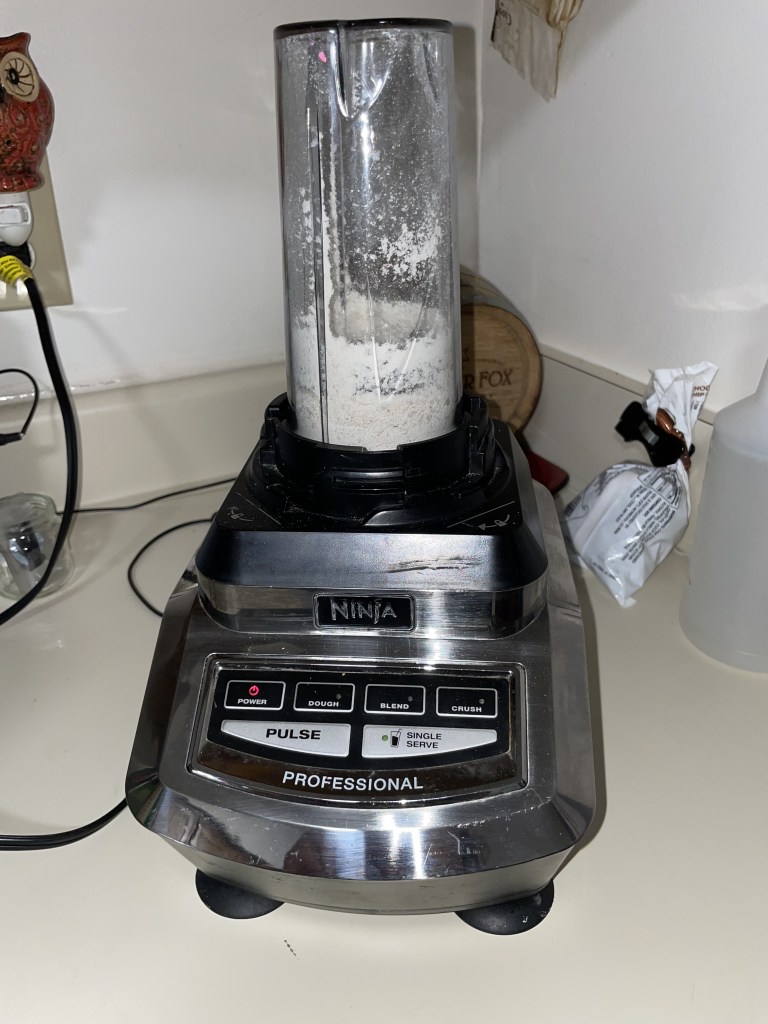
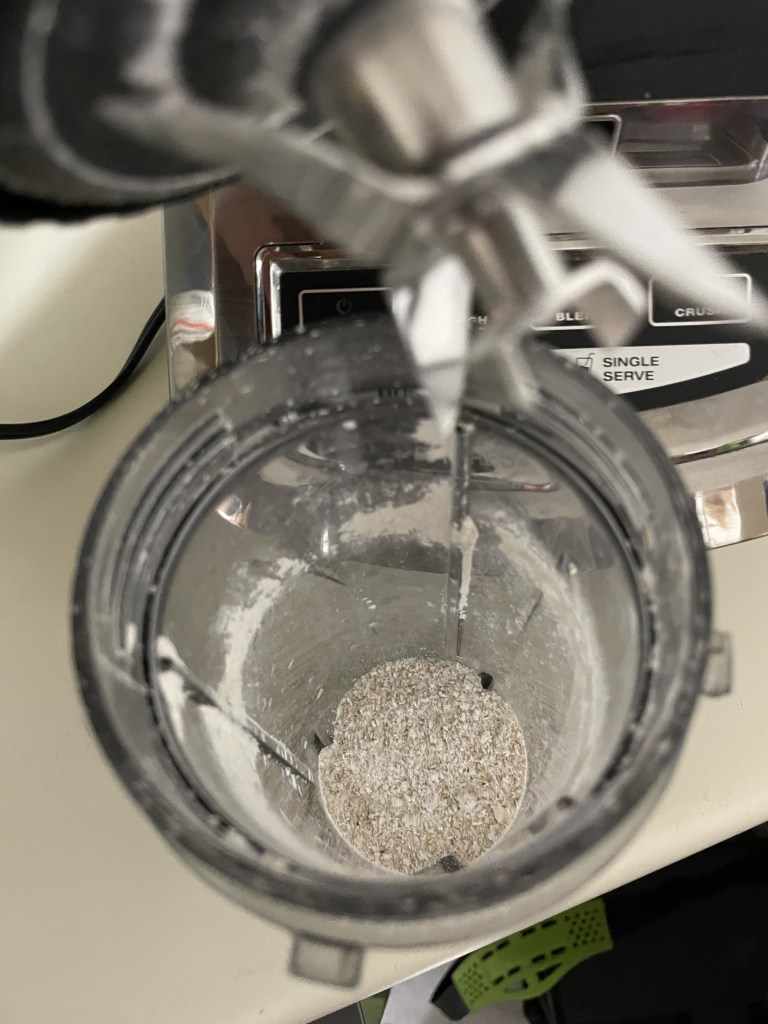
  • Grind up oats. If it mixes in with water turning it yellow, you’ve succeeded. It’s that easy.


Eczema Scrub

  • 1 tbsp of colloidal oats
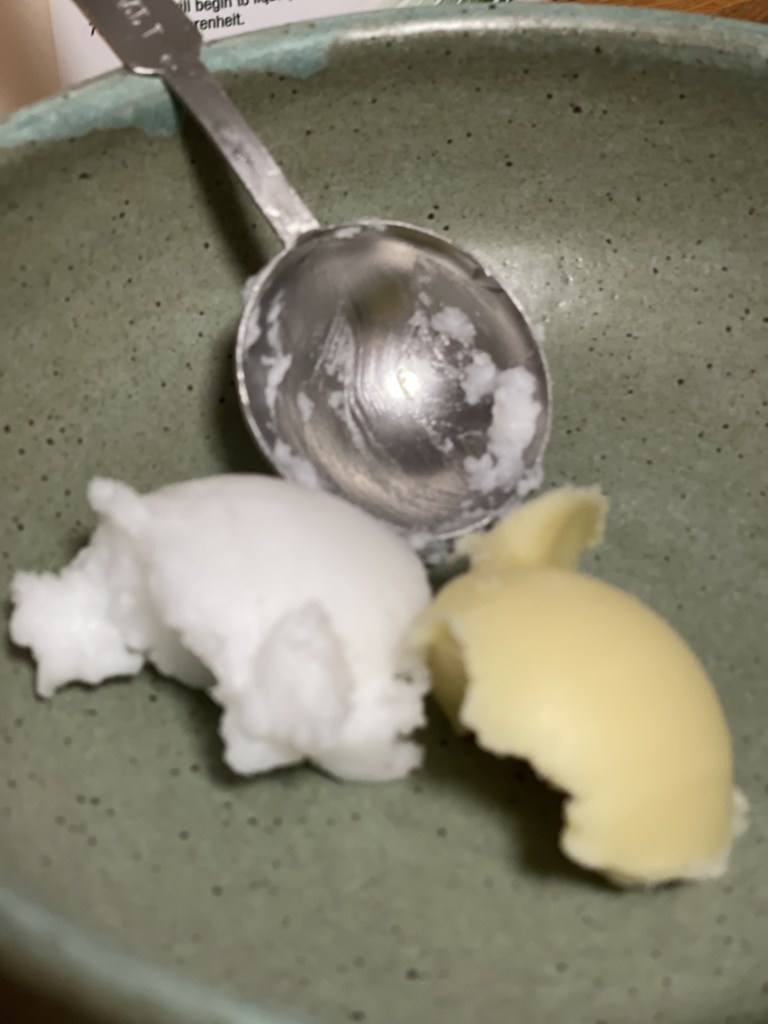
  • 1 tbsp of coconut oil – not melted
  • 1 tsp aloe vera gel

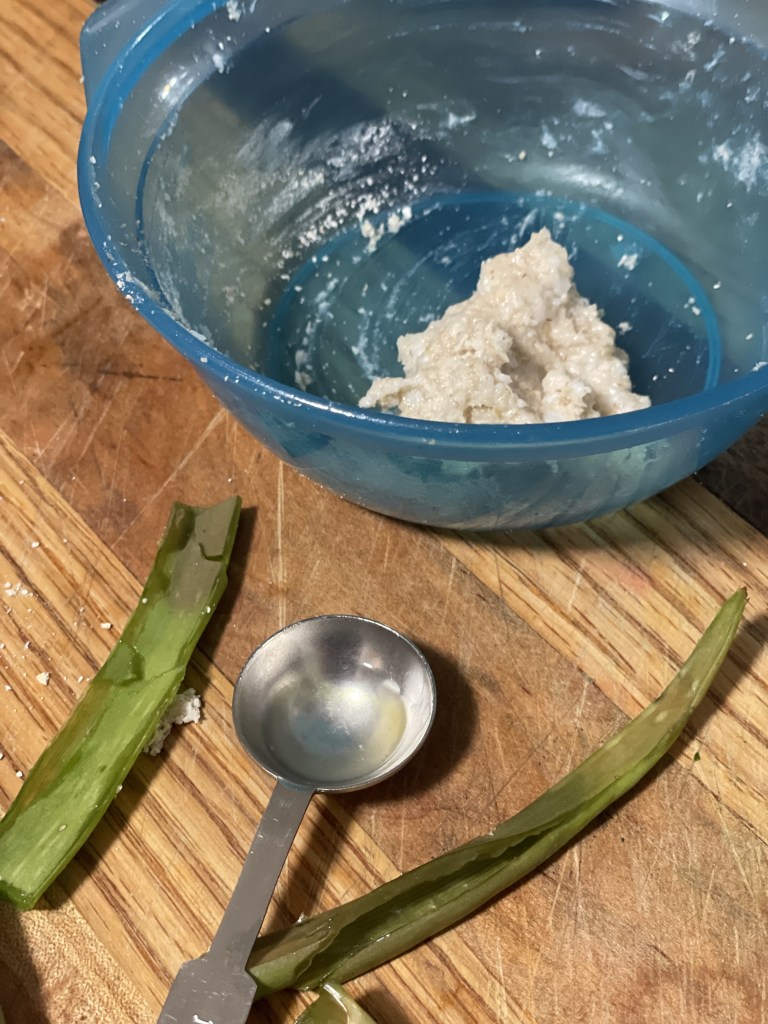
Mix it all together. Cover with plastic wrap. To use: Wash/Rinse hands as normal with soap. Using a small amount of the scrub, rub it onto your hands. Rinse off; pat dry. Your hands should be left oily. I would have added more aloe had my plant been more productive.

Eczema Ointment

  • 1 tbsp of colloidal oats
  • 1 tbsp of melted coconut oil
  • 1 tbsp of melted shea butter
  • 1 tbsp of honey
  • 1 tsp of aloe vera gel
  • 30 drops lavender oil
  • 10 drops of evening primrose oil

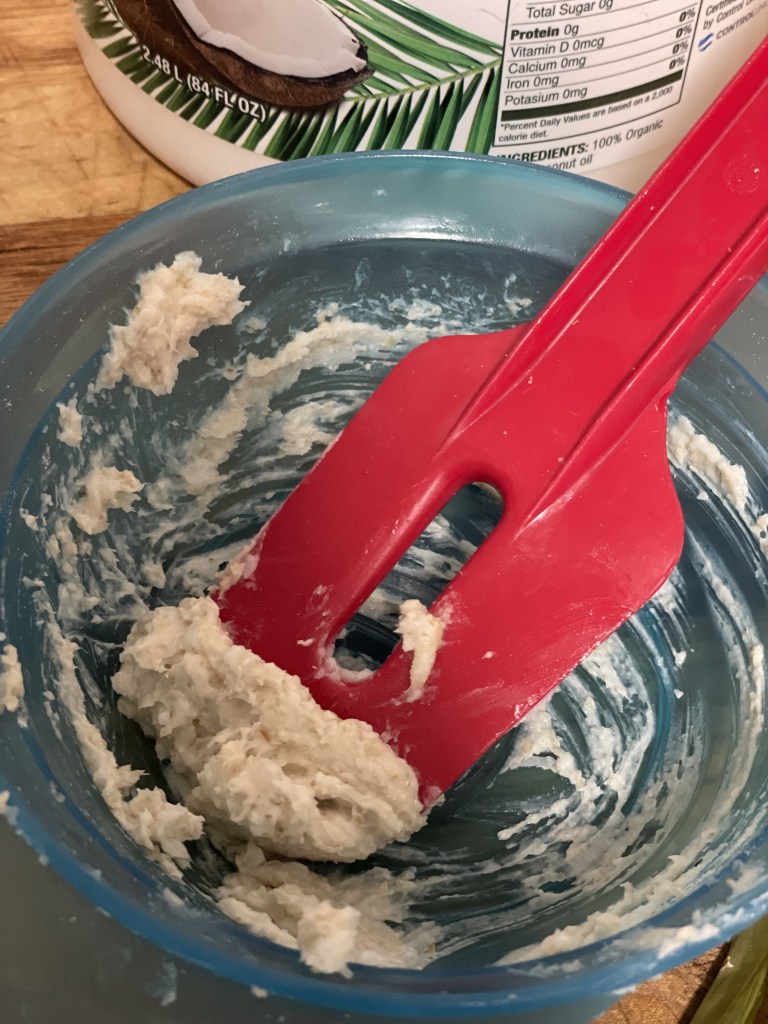
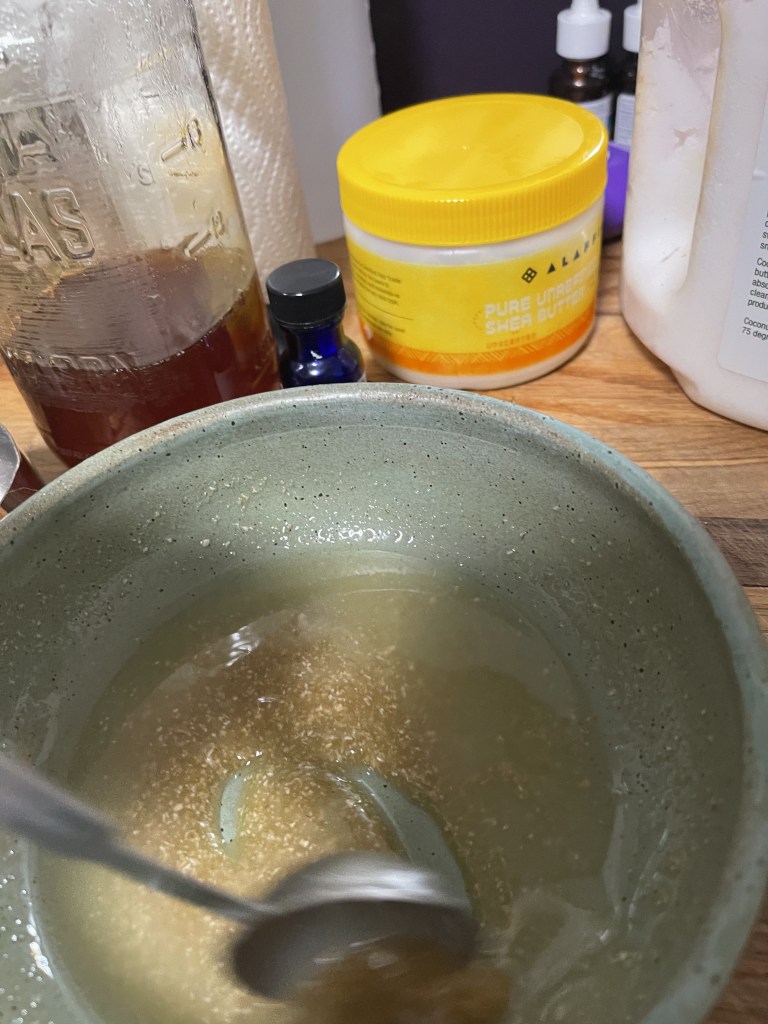
Melt coconut oil and shea butter. Add the oats, honey, aloe vera. Again, I would have added more aloe had my plant cooperated. Once fully mixed together and slightly lumpy, add the lavender and primrose oil. Keep mixing until it is the consistency you like. Put in the fridge. Let harden. Now, after this, you can leave it out at room temperature, but I prefer the cold temp, so I leave it in the fridge. Otherwise it gets too melt-y for me.

Thoughts

I wasn’t a fan of the primrose oil by itself, but in the mixture, it was fine.

I have mixed feelings on the oats themselves–a little messy. I would grind them up even more next time I make this, or hell, maybe just use an oat oil to replace the oats for the ointment. I’m sure it exists. For the scrub, I would leave it.

I also have mixed feelings about the honey because, well, it’s so sticky. Just be prepared to be sticky, I guess, is the answer.

Next time I make some I will use other ingredients–like jojoba, castor oil, etc. Since eczema is an unending fiend in my life, I imagine I will have yearly attempts at creating the best concoction. If not for me, then for the Dragon Skin Kid.

Does this meet the swellness check? Absolutely. Our skin started healing as soon as we started to use this stuff, and it was certainly less itchy.

A Series, Part Three: The Happy Middle. My Dosha Journey—A Personal Perspective on Ayurveda

By Guest Blogger Aekta Bandodker

Please read A Series, Part One: Background. My Dosha Journey–A Personal Perspective on Ayurveda and A Series, Part Two: How our Doshas Develop. My Dosha Journey–A Personal Perspective on Ayurveda prior to The Happy Middle. It will give you the proper background for understanding doshas in the context of my personal history.

We are living in the modern age where a Pitta mentality is usually seen as some kind of gold standard. Think: hustle culture and being “fast to beat your enemies,” “racing to the top,” and other external pressures to compete and “keep up with the best” or “become the best,” even if it means being untrue to oneself or one’s true desires and interests. Of course, this only makes things worse for all of us. Perhaps those with a sensitive temperament take a stronger hit, or feel the consequences of this pressure the most. 

At least, this was my experience. These perfectionistic tendencies ingrained into me by my parents’ own Pitta imbalances turned into a life recipe that I used for everything. From beating myself up over failures or perceived failures while also developing a habit of judging other people more quickly and harshly based on very arbitrary and frankly, just plain stupid standards.

This is not to say that having standards is stupid on its own. But the way my mind held them, and how it made little rules for almost every little thing…well, my mind became a prison that blocked me from true connection, both with myself and with the larger world. It didn’t help that this Pitta tendency of a fast paced, highly goal directed, competitive and aggressive modern life was more or less favored by most of society and it was rare to find friends, role-models, and adults who didn’t encourage or buy into this unhealthy toxic hustle story. (I’d like to add a reminder here that Pitta energy isn’t bad or negative on its own; it’s the overdoing of it that leads people to burn-out.) 

Sure, a lot of it may have been simply fueled by intergenerational trauma and the after-effects of my parents’ generation (at least in my specific ancestry) living in a way where they had to hustle hard to survive because it’s what life taught them to do. It was totally valid to their own experiences of becoming adults, so it wasn’t really a surprise that they would spill that mindset onto me. 

And yes, some of my own life has also shown me that I must “hustle,” or “work hard” to survive. That is a fact, and it’s not the whole picture or the only fact or really, as my own personal experiences have shown me, a fact that’s worth putting up on a pedestal above all other words of wisdom about life. Hustle culture and climbing up the hedonic treadmill is not as glorified as many who engage in it day in and day out make it out to be. At some point, or at multiple points if the person hasn’t yet hit their rock bottom, burnout is inevitable.

 We don’t have to live this way. 

At least, I won’t live this way because I don’t want to burn out again. I don’t take pride in the fact that I worked so hard that I couldn’t work anymore and had to spend a few years unemployed–to date–just to recover and heal.

So where’s the happy middle? How did I get from the combination of a Vata-dominant imbalance (think lots of “air energy”) compounded by a Pitta-encouraging culture that led me to develop a secondary Pitta-dosha imbalance when my internal fire (or agni in Sanskrit) burned too bright? Remember, Pitta is the fire element, and it hurt both me and those I loved. How did I get to how I feel now? I am more calm, less anxious, more accepting, barely competitive, and totally okay with where I am in my journey even if it doesn’t scream “successful”. This “success” in the way that either I or the majority of the people I know may have imagined or defined when we were younger did not lead to true satisfaction, but to exhaustion. 

The answer was always there, literally beneath my feet and around me, if only I had taken the time to slow down & notice. The answer was the Earth, the ground, the gentleness of water. All of these were my missing elements. I had overdone air and fire. Without the steady and nourishing elements of water and Earth in my life, I drove myself to exhaustion.

If you’re still having a hard time understanding the metaphorical language of the elements and how they weave through our human lives, the following are a few other ways they’ve been depicted that might help you grasp the idea better. Not all of them are necessarily stories created to demonstrate Ayurveda, but they still serve as good examples of showing the analogies between the elements of nature and human behavior and personality. 

○      The Disney Pixar movie Elemental

○      Effortless Action: The Art of Spontaneity YouTube documentary by Jason Gregory 

○      The Art of Effortless Living YouTube documentary by Jason Gregory

When I found myself on the bridge between trying to people-please–showing myself as some successful poster-child of my parents–and how I truly feel about the meaning of success and internal peace and happiness, my real life began. My Vata & Pitta dosha imbalances led me to burn out. I believe this is how I really began to understand who I am, all masks down and people-pleasing aside. When I was at my rock bottom and saw how trying to meet someone else’s idea of success had caused a lot of internal confusion by clashing with my true ideals, I began to decondition & came home to myself. I began to go within for validation and meaning, learning how to embrace how I really felt and nurture who I really was, despite the constant change and seeming “failure” my life may have looked like from the outside. 

If we’re only going by external, material factors–like having my own place, or having some kind of steady career that’s making me a lot of money–I have neither of those things at the moment. What I do have though, and no longer seek externally, is a general sense of inner peace and joy that comes from the little things in life that we can’t notice unless we slow down. 

I still have my Vata & Pitta tendencies; it’s not like I no longer embody anything from those dominant doshas, but the shift pre-burnout to post-burnout, as I write this a year after I first hit my rock bottom, is that there’s this third energy. This Kapha energy, the slow and deliberate, soft, and nurturing energy, that’s both steady and strong yet quiet. This “no need to boast or show off” energy that’s more stable has come into my daily rituals and how I approach the time I spend on my Vata-Pitta pursuits. This third energy is helping me ground, serving as the backdrop of inner assurance and calm that I’m finally allowing more space for. 

My natural baby Kapha energy, this bubbly little girl that I was before I turned 4 and headed on my Vata (and later Pitta) dosha trajectory, was never truly gone or lost. She was always here inside me, waiting patiently for me to let her come back to the forefront and give more voice to my life’s decisions. 

She never left me… I simply wasn’t listening to her and saw her more gentle approach as “weak”. Even though at the moments in my life where I have been the most proud of myself, or have needed myself the most and shown up, this softness and vulnerability, and my capacity to be sensitive, has been anything but “weak.”

My sensitivity has been the beacon of light in my darkest hours, and if ever I saw it as “weak,” it was just another internalized and unhelpful, ultimately destructive message I had taken on from those who had lost touch with their own vulnerability–their own inner child and the place in which true compassion lives. Now that I understand this, from years of continuing therapy and just coming out of my worst-yet rock bottom, I don’t see it as shameful or anything to hide. In fact, gentleness is what is saving me and helping me recover, and not just recover, but thrive while I recover and rebuild my life in a way that honors and makes space for this slower pace of movement through all that I have to do.

I am returning home to my truest self–my Prakriti. My internal landscape is beginning to shift, slowly informing and influencing my external one to change along with it. I am gaining weight where I used to be underweight, and I am not forcing things to happen but learning to respond more to what life has to offer me. I feel more like “myself,” in the purest sense of the phrase of what it means to be “oneself,” and it’s quite loosely defined. It has room to change and breathe and make mistakes and take things slowly, knowing that rushing to the ends of things really sucks the joy out of the entire purpose of life-which is to savor, and cherish, since life itself naturally feels like it’s moving faster as we grow older and we don’t need to run anywhere to make a home run. 

It’s not like I never connected with the elements of earth and water previously, but the shift has been in the effort I put towards this connection. In the past, with my Vata-Pitta dosha driven mindset, I wouldn’t have counted sitting in the backyard or briefly walking around my parent’s house or the neighborhood as a nurturing, Kapha activity.  Because of the pressure I put on myself about going to the park, I was missing out on what was always available to me right outside my doorstep. 

Now I spend at least 20 minutes everyday in the yard and sometimes longer if I decide to stroll the neighborhood or attend to the plants my parents are growing. Both ways (going to the park for a long hike and spending time in a home-garden space) are still grounding and encouraging of balancing through Kapha, but my attitude about it is what’s making a real difference in me truly feeling its effects. Afterall, it’s more relaxing to simply step outside my room for half an hour and take in the fresh air without getting out of my pajamas, than it is to think less of myself for not putting in the effort to go to the park (which, if I forced myself to do it, would aggravate my Pitta imbalance anyway since this summer has been so hot!).

I’ve learned that sometimes, it’s not even the activities we do, but the approach we take towards them. In this case, less effort for the same deal is yielding a better sense of well-being for me. Whenever it’s not too hot for the park, I am also spending more time by the lakes and bodies of water. It’s quite meditative and soothing to stare at the ripples that glimmer under the light and it immediately calms my nervous system. 

Other ways in which I’m helping rebalance my doshas by adding Kapha are by planning my activities around my meal times and giving myself more time to savor what I’m eating, rather than waiting to rush to the next activity. I’ll admit that I still look forward to what’s next and it’s still a work-in-progress for me to go through all of my meals without my phone & without my entire focus on my food. But by paying attention to how my body feels when I eat and do other activities, I am better able to discern when it’s time to simply focus on my food and when it’s okay to divide my attention between eating and something else. It’s definitely not the easiest task but I am finding more and more ease with it as I practice truly savoring my food and spending more time in the kitchen, even down to what I eat. Adding more ghee and rich soups, preparing softer meals that are easier to digest and more dense in their composition are some ways that I am literally adding more weight in my system to help me ground. 

Re-designing my life around my somatic needs in this way is naturally creating more breaks for me that act as buffer-times between other task-oriented activities and this is creating a new routine where personal check-ins are not left for the end of the day or just dreamt about in the beginning before the day “carries me away.” Rather, my overall pace is less rushed so that I feel like I am really the one engaging in the day intentionally rather than the day simply “happening to me.” My life is not one continuous sport & I’m not trying to race to my deathbed. This newfound & balancing Kapha energy is very beautiful. I hope to seep in more of it in the coming months as I travel to India, reconnect with my roots, & engage in various Eastern medicine programs to support my recovery. 

I’d like to thank my parents, my grandmother who has passed away but continues to live with me in spirit, my brother, and my closest friends and mentors for supporting my recovery journey. Although my parents may have unintentionally contributed towards some of my unhealthy internalized belief systems that led to my dosha-development when I was younger, I am still grateful for their understanding in the choices I am making now as I’ve begun unlearning habits and modes of being that no longer serve me & stunt my growth. 

I truly believe our parents, as well as our friends, mentors, and the larger circle of people in our growing environment do the best they can with where they are on their own journeys. It is ultimately up to us to discern if something is hurting or helping us and take a different path. Everyone on our path is a teacher and a student in this way, so I also thank you, as the reader, for making it to the end of this 3-part series and hope you gained something from witnessing my journey. I look forward to deepening my understanding of Ayurveda in India and hope to share a full-recovery blog post in the near (or distant) future since recovery has its own timeline & I wouldn’t be honoring the Kapha in my life if I were to rush its process!

Aekta Bandodker is a lover of knowledge and an artist through and through. She believes in the healing power of self-expression and story-telling and the liberation that it provides in transforming trauma. She loves to help people change their inner narratives so that they can take back ownership of their lives. Her favorite activities include spending time with close friends and family, listening to music, learning through audiobooks and podcasts, writing or creating art, and spending time in nature. Check out her website here!